
 |
 |
 |
||||||||||||
 |
|
 |


SYSTEMS 
Scaffold World is one of South Africa's leading manufacturers of scaffolding and formwork for the construction market.
Scaffold World is a manufacturer of scaffolding systems. We offer a comprehensive range of scaffolding systems, protective systems and event systems, plus
rolling scaffolds and tower scaffolds. Scaffold World provides total flexibility to lock in any angle plus quickly and accurately aligns at 90 degree angles using the keyhole positions.
Scaffold World manufactures and supplies a full range of products that includes the conventional decking system, access scaffolding
(Quick-stage and Quick-lock) and formwork for bridges, reservoirs, concrete slabs and columns.
Quick stage System
 Perfect for reaching those difficult heights, and ideal for use on site for plastering, building, painting, electrical and plumbing tasks (caption)
Quick stage scaffolding is a tube structure to support people and material in the
Perfect for reaching those difficult heights, and ideal for use on site for plastering, building, painting, electrical and plumbing tasks (caption)
Quick stage scaffolding is a tube structure to support people and material in the
construction industry or repair of buildings and other large structures. This system can also be used for propping of slabs and formwork.
The key components of Quick stage are standards, ledgers, base jacks and hook-on boards. The standards, also called uprights, are the vertical tubes that transfer the entire weight of the structure to the ground where it rests on the base jack.
The adaptability of the system enables the standards to be erected close together where necessary to accommodate heavy loads on the scaffold.
The ledger consists of horizontal tubes (also called transoms) which connect between the standards.
Scaffold World Systems specializes in the Scaffolding Hire, Scaffolding Sales and Scaffolding Erection of all Kwik-Stage Scaffolding and Formwork.
We offer a comprehensive solution to meet our clients scaffolding and formwork requirements and we can take on all projects either be large
or small. Our experienced rigging teams will erect, dismantle and move materials according to our clients needs
safely and efficiently.
Our Scaffolding division is extensively experienced in erecting:
- Access scaffolding,
- Bridging platforms,
- Suspended platforms,
- Seating stands and stages,
- Mobile towers,
- Birdcage scaffold,
- Self-Lock Towers,
- Pool covers, and more
Slab Form Work & Decking
Team work at construction site, workers passing metal formworks on scaffolds (caption)
Form Work is a scaffolding system commonly used for decking and the casting of concrete columns, walls and floor slabs during the construction of high-rise buildings, bridges, reservoirs and other similar projects. The scaffolding is constructed in the specified shape to create a mould where concrete is typically poured to harden. Scaffold World has expertise in a variety of form work projects
and will be able to supply the required materials for your project.
The system consists of only 6 basic components:
- Base jack
- Standard
- Ledger
- Double-headed jack
- Quick strip beam
- Deck panel
mini factories etc...
Erection of Scaffolding

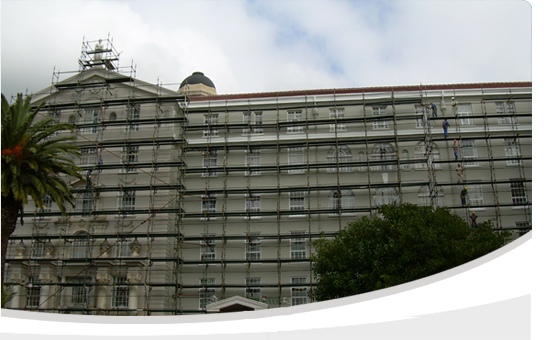
Scaffolding is erected to safely support workers on a level surface that's elevated for construction or painting jobs
Scaffolding is erected to safely support workers on a level surface that's elevated for construction or painting jobs (caption)
Scaffolding is erected to safely support workers on a level surface that's elevated for construction or painting jobs. The most common type of scaffold, or pipe staging, is a steel tube frame scaffold
erected on the outside of a building. Scaffolding can be built to reach the upper level of a single story building, or as high as the upper floors of a skyscraper.
Health and Safety for workers as well as the Public

Safe erection and dismantling sequence that must be followed
Protection of the public
When scaffolding operations are in progress the public must be excluded from both the area of work and a sufficient area around it. Steps to ensure this will include:- Obtaining a temporary pavement or street closure whilst operations are carried out
- Undertaking operations in quiet hours i.e. early morning, at night or at weekends
- Incorporating fans, crash decks and tunnels as early as possible into a scaffold
- Erecting barriers and signs and diverting the public away from operations
- Storing scaffold clips and other loose materials safely on the scaffold
- Not raising or lowering materials over members of the public or other site workers.
- Also consider that disabled persons need proper access along pavements covered by scaffolding.
Scaffolders working at height
Scaffolds must follow safe systems of work to prevent people falling. In particular: When lifting or lowering materials, scaffolders must be clipped on or working
within a handing platform that is fully boarded, with double guard-rails and toe boards A minimum 3 board working platform together with a single guard-rail is
provided as erection or dismantling works progress Safety harnesses to be worn a all times by scaffolders and fitted with a 1.75m length lanyard and a 55m opening scaffold
hook or similar for one handed operation Harnesses should be clipped on to a secure anchorage point requires the following minimum conditions:
1. The scaffold must be tied in to a sound structure as work progresses:
2. Attachment can be made to a ledger, transom or guard-rail supported with load bearing couplers or a transom supported by ledgers in a lift above fixed at both
ends by single couplers.
At least one bay of a scaffold should remain boarded out as work progresses and this should be used for ladder access for scaffolders for the full height of the
scaffold Safe ladder access for scaffolders should be incorporated as early as possible into the erection process Scaffolders should not be clambering up and down
scaffolds without proper ladder access and safe working platforms provided on each lift being worked on.
Stability of scaffolds
Each year there are a number of scaffold collapses across the country. To make sure your scaffold does not collapse you should ensure that:
The anchors specified to tie a scaffold to a structure are suitable for the base material and that they are installed correctly
Scaffold anchors or ties are installed as
erection work progresses. Conversely, they should not be removed too early during dismantling operations
More ties will be needed on a sheeted or netted scaffold
to ensure its stability
Scaffolds are not overloaded with equipment, especially tube and fittings, during erections or dismantling operations.
HD 200 Heavy-Duty Prop Shoring
When using prop sections made of steel, max. 2 x HDS 30 Alu can be used!

Prop Sections

Lowering Devices HDA
Only use fully extended. Never use an impact wrench to operate as this can break the Shear Pin HDA, Item. 022018!

Head Spinle HDK 45
Head spindle for the Heavy Duty Prop HD 200. With intergrated chord couplings for the connection. Allow titling in one direction by 3°.

Multiprop MP
Can be used individually, as well as in combination with MULTIPROP MRK Framestableforms or shoring towers.

Frames MRK
Complete with: Wedge Coupling for connecting to Multiprop

Peri Multiprop System
The MULTIPROPs braced with frames can be used as tables or shoring towers.

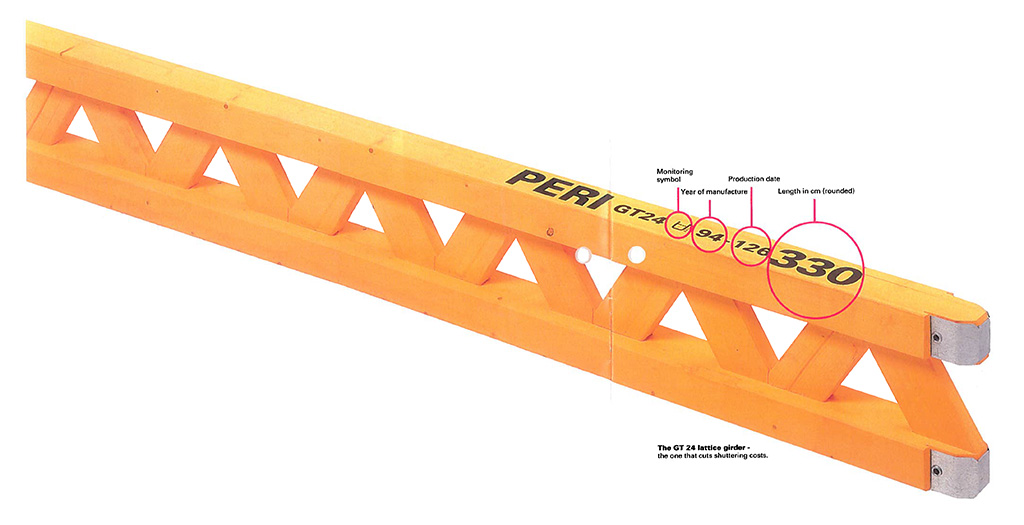
GT 24 Girder
To simplify handling the most common GT 24 Griders are colour coded for length.

GT 24 Lattice girder
Designed to last by timber specialists. The patented chord with finger joints has practically no cavities that could trap water, and the latticwork is well ventilated even while the griders are stacked.
Trio Panel Formwork


Domino
Domino panels are extremely light yet withstand a high load.

Peri Domino
Corners, T-junction and infilling.

